

Ever wondered why the same skincare routine works differently at twenty-five than it does at forty?
The usual answer is that we lose collagen, and that is true. But there is a more interesting question underneath it. Where does collagen live, who makes it, and is the maker still doing well?
This article invites you to take a look beneath the skin with us, through an idea we call ECM Reset. Where research backs something up, we will say so. Where it is still an intriguing possibility, we will say that too.
01 There is a weaving mill beneath your skin
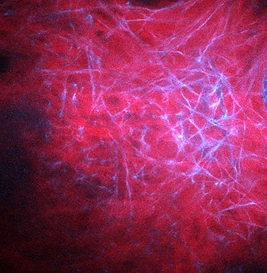
ECM stands for extracellular matrix, the network outside our cells. It sounds remote, but it is actually most of the dermis. It holds collagen fibres for strength, elastin fibres for stretch, and water-holding substances such as hyaluronic acid tucked between the fibres [1][2].
Picture a length of fabric stretched tight on a loom. The fabric is the ECM, and the person sitting at the loom is a cell called the fibroblast. The threads represent the collagen and elastin fibres that fibroblasts make. The weaver adds new threads and mends the fabric already on the loom [1].
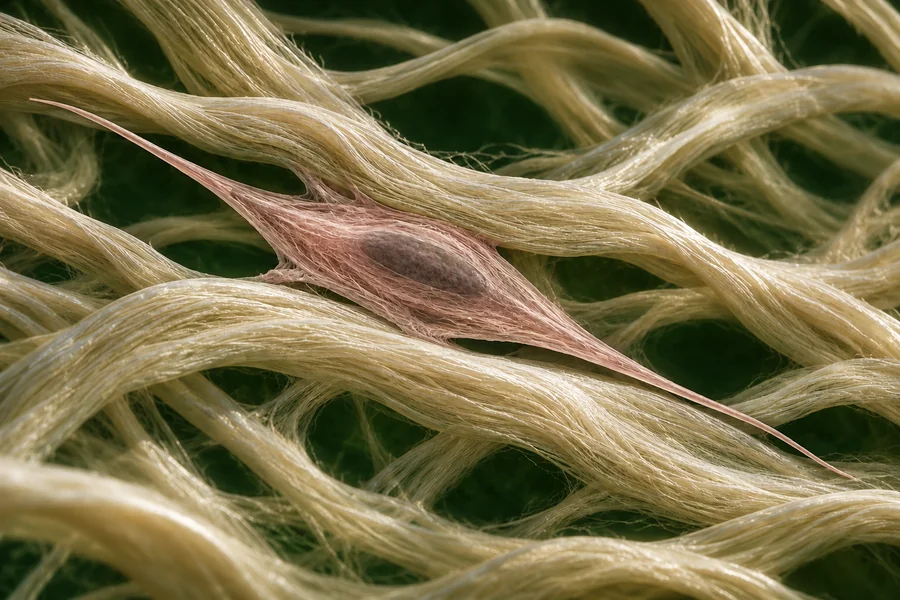
What researchers at the University of Michigan have described is quite remarkable. The weaver works best when the fabric is taut. Fibroblasts need to hold on to intact collagen fibres and feel the tension in them in order to build more than they break down [1][3]. Put simply, the weaver and the fabric look after each other.
02 Then one day the fabric starts to sag
As we age, collagen fibres gradually break into shorter pieces and there are fewer of them [2][4]. The fabric sags, so the weaver loses its grip. With a weaker grip, it weaves less and releases more of the enzymes that break collagen down. The fabric sags even more, and the cycle keeps turning [1][3].
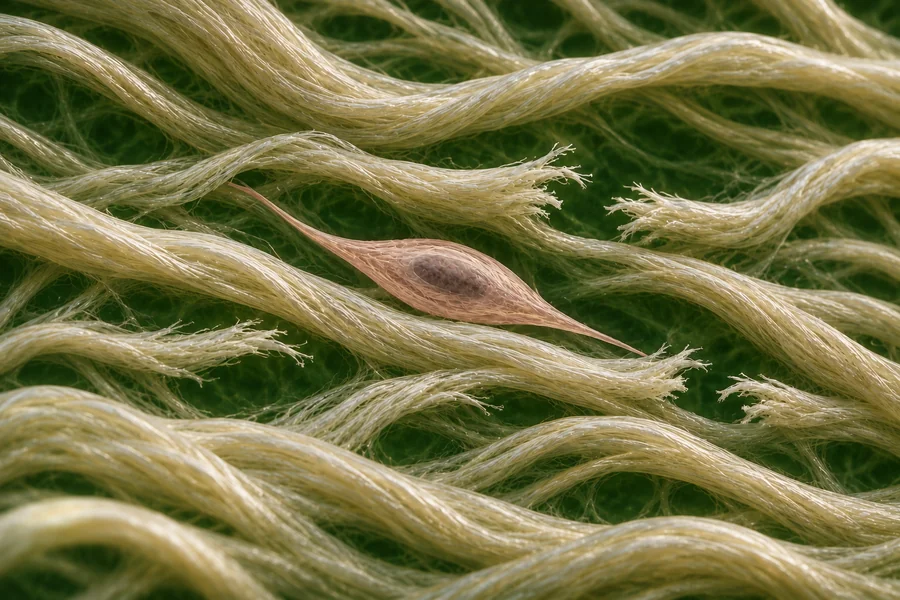
- Collagen fibres fragment
- Fibroblasts lose tension
- Less matrix is made and more breaks down
What we see in the mirror is wrinkles and skin that is less springy [2].
At this point the question changes completely. It is no longer how to add collagen, but how to look after both the fabric and the weaver so the mill keeps running for a long time. That is the heart of skin longevity, keeping skin in good condition for longer.
One small note. Skin longevity is a direction for skin care, not something research can measure directly yet. The ECM mechanisms described here, however, are well supported by research.
03 What if we could start the mill afresh?
Here is our theory. If the cycle of decline comes from slack fabric and a tired weaver, starting over would likely take three beats: clear away what has worn out, send the signal for repairs, and look after the weaver while the repairs are under way.
We call this idea ECM Reset. Reset means a fresh start for the environment of the skin. It does not mean your skin goes back to twenty, and no research confirms that skin age can be reversed.
04 So what makes an ECM Reset happen?
Let us go through it beat by beat: how each step can happen, and how far the evidence has come.
Clearing out old collagen with monopolar RF
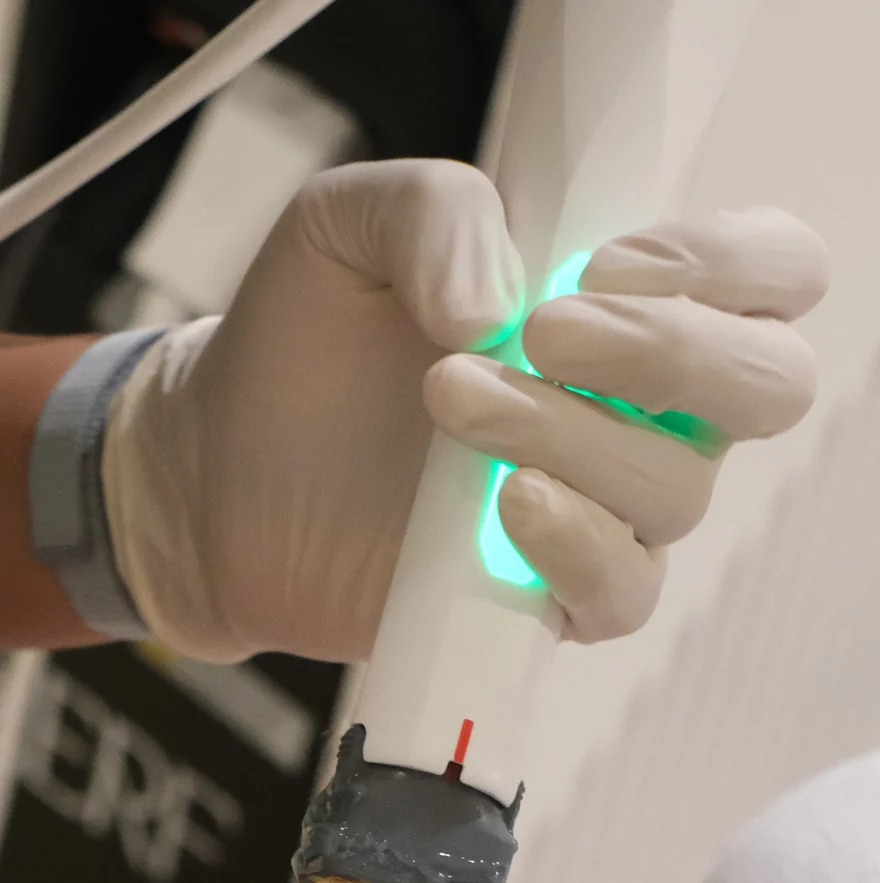
Monopolar RF sends radio-frequency energy through the skin to create heat in the dermis and deeper layers, without needles. XERF is a device in this group that delivers energy at two frequencies, 6.78 and 2 megahertz, so that heat spreads through skin layers at different depths [6][8].
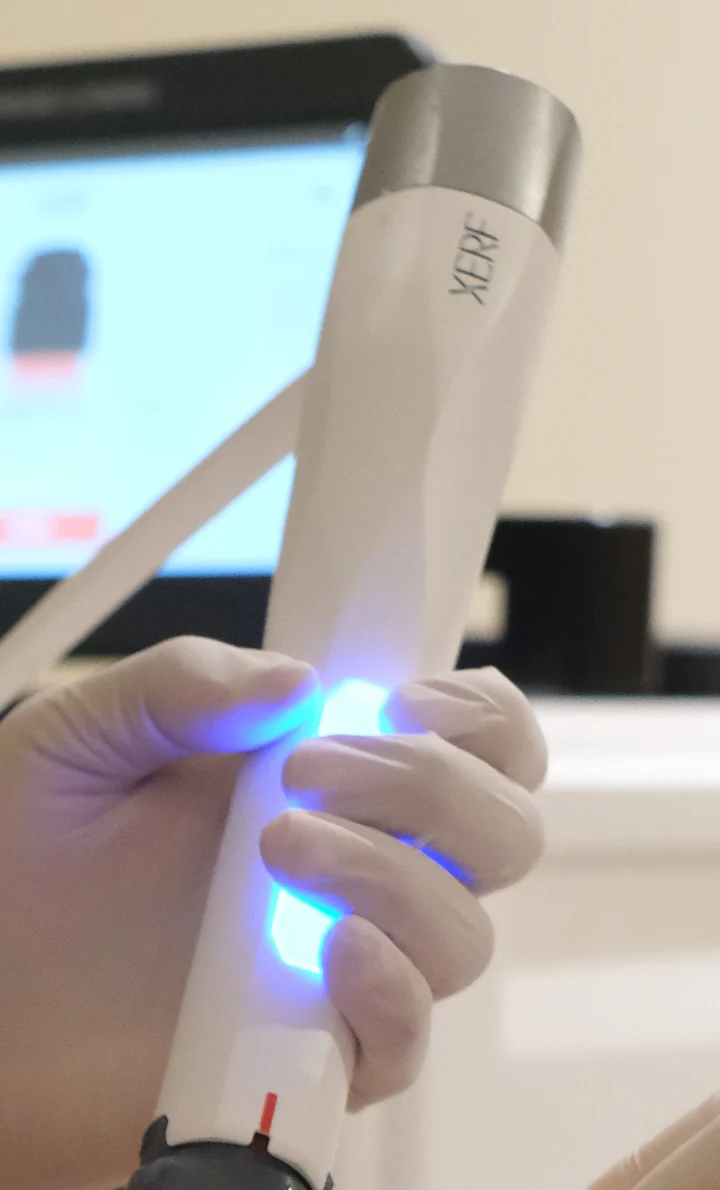
Collagen fibres are a little like twisted rope. Under carefully controlled heat, some of the twists loosen and contract. A study using electron microscopy after monopolar RF found that some collagen fibres became thicker with less distinct edges immediately after treatment, and the gene used to make type I collagen became more active [5].
In the language of the mill, the heat clears some worn fibres out of the fabric, so the body sees that spot as needing repair. Once the cleared material has been tidied away, the weaver has new work to do: weaving fibres back in [5][7].
A review of tissue studies after monopolar RF reports that collagen content increases from immediately after treatment up to six months, along with changes in elastin and thicker skin layers [7]. In pig skin treated with both frequencies together, collagen and elastin were reorganised, more widely and for longer at later follow-up [6]. In people, studies of 39 and 16 participants found improvements in laxity and skin quality at three months [8][9].
More concentrated heating
Broader, deeper heating
RF glow: the first sign the mill is stirring
Many people notice that after RF their skin looks clearer and more luminous. Some see it on the first day, others more clearly over the following weeks. We simply call this RF glow.
At first, heat makes the fibres contract, the skin tightens slightly, and more blood and fluid reach the upper dermis for a while. An animal study found the upper dermis expanding with fluid and blood during the first half of a course of RF [11]. Skin that is plumper and smoother reflects light more evenly. In a study of 45 people treated with 6.78-megahertz monopolar RF on a different device, skin roughness dropped immediately after treatment and was still better than baseline a month later [10].
Next comes the phase when the mill gets to work. The ECM is not only fibres; water-holding substances sit between them too. In animals given six RF sessions, the later stages showed more cells along with increases in collagen, elastin and water-holding mucopolysaccharides [11]. A small study of 10 people with sensitive skin, treated twice with monopolar RF in a shallow mode, found skin was better hydrated and lost less water at four and eight weeks [12].
Skin roughness
Measured immediately after treatment and at one month
- Immediately
- 1 month
Hydration and water loss
Measured at four and eight weeks
- 4 weeks
- 8 weeks
Ask Thai women what glowing skin means and one study found the answer is skin with radiance, bounce and an even tone [14]. Bounce and hydration are matters of the ECM itself. So we see RF glow as the first visible sign, on the surface, that the mill is stirring.
PN: looking after the weaver during repairs
Once the clearing and signalling are done, the real work is repair. Two parties work side by side here: clean-up cells called macrophages, which remove damaged material and send signals, and the fibroblast weavers who do the new weaving.
PN, or polynucleotides, are purified DNA strands derived from fish. They are used in the Plinest Programme as a gel that a doctor injects into the dermis. In Thailand, the product is licensed for import as a medical device [24].
In recent experiments, PN helped older macrophages switch from an inflammatory mode to a repair mode. What those macrophages released led fibroblasts to make more type I and type III collagen, and in older animals collagen density and skin elasticity improved over time [15]. Another laboratory study found that PN used together with hyaluronic acid helped fibroblasts damaged by UVA recover and show better expression of ECM-building genes [16].
View the microscopy image
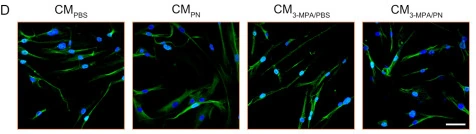
The fibroblast images show where NF-κB is located. Panels F and G of the same figure report type I and III collagen measurements separately.
In the language of the mill, PN helps the clean-up finish at the right moment and helps the weaver have enough raw material and moisture for the work coming in.
A study of 30 Asian participants who received three injections of PN-HPT found smoother, firmer, more even-toned skin, with results still present at six months [17]. Real-world data from 66 people in Italy showed most doctors and patients rated their skin as improved [18]. Expert groups also suggest using PN to prepare the skin before, or alongside, other procedures [20][21].
The big picture: three beats of a Reset
Taken together, ECM Reset in our theory has three beats: clear, signal and rebuild. Monopolar RF handles the first two, PN comes in for the last, and RF glow is what you can see along the way.
- Clear worn fibres
- Signal repair
- Rebuild the matrix
05 So what should come first?
No research answers this directly yet. What we have is reasoning from the mechanisms, which points two ways.
The first way starts with the Plinest Programme, to prepare the environment so the weaver is ready, followed by XERF. This fits the idea of priming in expert consensus documents, meaning preparing the skin before other procedures [20][21].
The second way starts with XERF, then waits about one month before the Plinest Programme. The reasoning is that early after RF, the body uses a mild inflammatory signal to call in repairs, and experiments found that PN helps clean-up cells switch from an inflammatory mode to a repair mode [15]. BEHAP's approach is therefore to let that signal do its work first, and then bring in PN to support the repair phase. This is a hypothesis that has not yet been tested.
One more piece of information to weigh: a split-face study of 25 people who received PN immediately after microneedle RF found no reduction in results [22]. So the right sequence depends on each person's skin, goals and their doctor's assessment.
06 At a glance
| Topic | What we know so far | Strength of evidence |
|---|---|---|
| The ECM declines with age in a self-reinforcing cycle | Fragmented collagen reduces fibroblast activity [1][2][3][4] | Reviews of laboratory and human skin research |
| Monopolar RF, clearing and rebuilding | Heat makes fibres contract, followed by new collagen production [5][6][7] | Small human skin studies, animal studies and a review |
| XERF in people | Improved laxity and skin quality at three months [8][9] | Studies of 39 and 16 participants |
| RF glow | Smoother skin straight away and better hydration over several weeks [10][12] | Small studies. None measured glow directly after XERF. |
| PN and repair | Helps switch the mode of clean-up cells and increases collagen production [15][16] | Laboratory and animal studies |
| PN in people | Improved skin quality in studies and real-world use [17][18][19] | Low to moderate evidence |
| Combining both programmes | Mechanistic reasoning, but no direct study yet [22][23] | Hypothesis |
| Long-term effect on skin longevity | Awaiting long-term follow-up | Still an open question |
07 If you would like to explore further
ECM Reset is not a formula for success. It is a way of looking at skin that invites a question: what is the environment beneath your skin like right now, and where should care begin? If you would like to talk this through with a doctor, bring along any questions this article has left you with, and let the doctor assess which approach suits your skin, or whether you need to do anything at all yet.
Frequently asked questions
Can ECM Reset make skin younger?
No method can truly reverse skin age. Reset in this article means a fresh start for the environment beneath the skin, so the repair and rebuilding mechanisms can work better. Results vary from person to person.
Do I need both programmes?
No. Each programme has its own evidence [8][9][17][18]. Combining them is an idea that has not yet been tested directly in research. Your doctor will assess where to start, or whether you need treatment at all.
How long does RF glow last?
Part of the plumpness and smoothness on the first day comes from mild swelling that settles within a few days [10]. Changes that follow from the rebuilding process have been reported in studies over one to three months [8][9][12]. The actual timeline varies from person to person.
Can both be done on the same day?
One study injected PN immediately after microneedle RF and found no reduction in results [22]. BEHAP's approach, however, is to wait about one month after XERF, or to begin with the Plinest Programme first. Your doctor will decide case by case.
Related programmes
Related articles
References
- Cole MA, Quan T, Voorhees JJ, Fisher GJ. Extracellular matrix regulation of fibroblast function: redefining our perspective on skin aging. J Cell Commun Signal. 2018;12(1):35-43. doi:10.1007/s12079-018-0459-1
- Shin JW, et al. Molecular mechanisms of dermal aging and antiaging approaches. Int J Mol Sci. 2019;20(9):2126. doi:10.3390/ijms20092126
- Fisher GJ, et al. Skin aging from the perspective of dermal fibroblasts. J Cell Commun Signal. 2023;17(3):523-529. doi:10.1007/s12079-023-00743-0
- Quan T, Fisher GJ. Role of age-associated alterations of the dermal extracellular matrix microenvironment in human skin aging. Gerontology. 2015;61(5):427-434. doi:10.1159/000371708
- Zelickson BD, et al. Histological and ultrastructural evaluation of the effects of a radiofrequency-based nonablative dermal remodeling device: a pilot study. Arch Dermatol. 2004;140(2):204-209. doi:10.1001/archderm.140.2.204
- Ko K, et al. Computational modelling and porcine tissue study of 6.78 and 2 MHz RF. Lasers Med Sci. 2025;40(1):501. doi:10.1007/s10103-025-04746-8
- Goldman MP, et al. Monopolar radiofrequency-induced fibroblast stimulation for the prevention and improvement of skin laxity (includes authors from the device manufacturer). Dermatol Surg. 2025;51(9S):S38-S43. doi:10.1097/DSS.0000000000004714
- Weiss RA, et al. Prospective multicentre study of dual-frequency RF in 39 participants. Cureus. 2026;18(3):e104546. doi:10.7759/cureus.104546
- Erlich G, Dahan E, Wolf Y. Retrospective study of XERF in 16 participants. Lasers Med Sci. 2026;41(1). doi:10.1007/s10103-026-04996-0
- Kim J. Evaluating the efficacy of continuous water-cooling 115-watt 6.78-MHz monopolar RF therapy for fine wrinkle reduction. Plast Reconstr Surg Glob Open. 2024;12(2):e5623. doi:10.1097/GOX.0000000000005623
- Alvarez N, et al. The effects of radiofrequency on skin: experimental study. Lasers Surg Med. 2008;40(2):76-82. doi:10.1002/lsm.20594
- Ryu HG, et al. A novel variable-pulse monopolar RF mode selectively targets the upper dermis to improve barrier dysfunction in sensitive skin (includes authors from the device manufacturer). Ann Dermatol. 2026;38(5):419-427. doi:10.5021/ad.26.023
- Bernardy J, et al. Radiofrequency and targeted ultrasound enhance natural hyaluronic production: a pilot porcine study. J Ultrasound. 2025;28(4):1001-1006. doi:10.1007/s40477-025-01083-y
- Kelkar R, et al. Characterizing the skin of Thai women and its glow by combining consumer assessments and instrumental methods. Int J Cosmet Sci. 2025;47(5):827-834. doi:10.1111/ics.13071
- Byun KA, et al. Laboratory and animal study of PN with macrophages and fibroblasts. Int J Mol Sci. 2025;26(17):8720. doi:10.3390/ijms26178720
- Tran TTT, et al. Laboratory study of HA and PN with UVA-exposed fibroblasts. Sci Rep. 2026;16(1):6703. doi:10.1038/s41598-026-37730-5
- Lim TS, et al. Study of PN-HPT in 30 Asian participants. Clin Cosmet Investig Dermatol. 2024;17:417-431. doi:10.2147/CCID.S437942
- Lanza E, et al. Real-world data on PN-HPT use in 66 people. J Cosmet Dermatol. 2026;25(1):e70532. doi:10.1111/jocd.70532
- Lampridou S, et al. Systematic review of PN in aesthetic medicine. J Cosmet Dermatol. 2025;24(2):e16721. doi:10.1111/jocd.16721
- Lim TS, et al. Fine-tuning treatments with PN HPT devices to improve Asian skin quality: the ACES consensus (sponsored by the manufacturer). Clin Cosmet Investig Dermatol. 2025;18:2979-2993. doi:10.2147/CCID.S551492
- Cavallini M, et al. Consensus report on the use of PN-HPT in aesthetic medicine. J Cosmet Dermatol. 2021;20(3):922-928. doi:10.1111/jocd.13679
- Kim J. Split-face study of PN after microneedle RF in 25 participants. Plast Reconstr Surg Glob Open. 2026;14(9):e8109. doi:10.1097/GOX.0000000000008109
- Rho NK, et al. Survey of PN use among 235 Korean dermatologists. J Cosmet Dermatol. 2024;23(4):1243-1252. doi:10.1111/jocd.16125
- Thai Food and Drug Administration. Medical device import licence no. 67-2-1-2-0002773, issued 21 March 2024.