


Start with the exact product name
Vitaran is made by BR PHARM in South Korea, while Plinest is made by Mastelli in Italy. Each brand may have different formulations for different uses, so establish the exact product the clinic will use before comparing them.
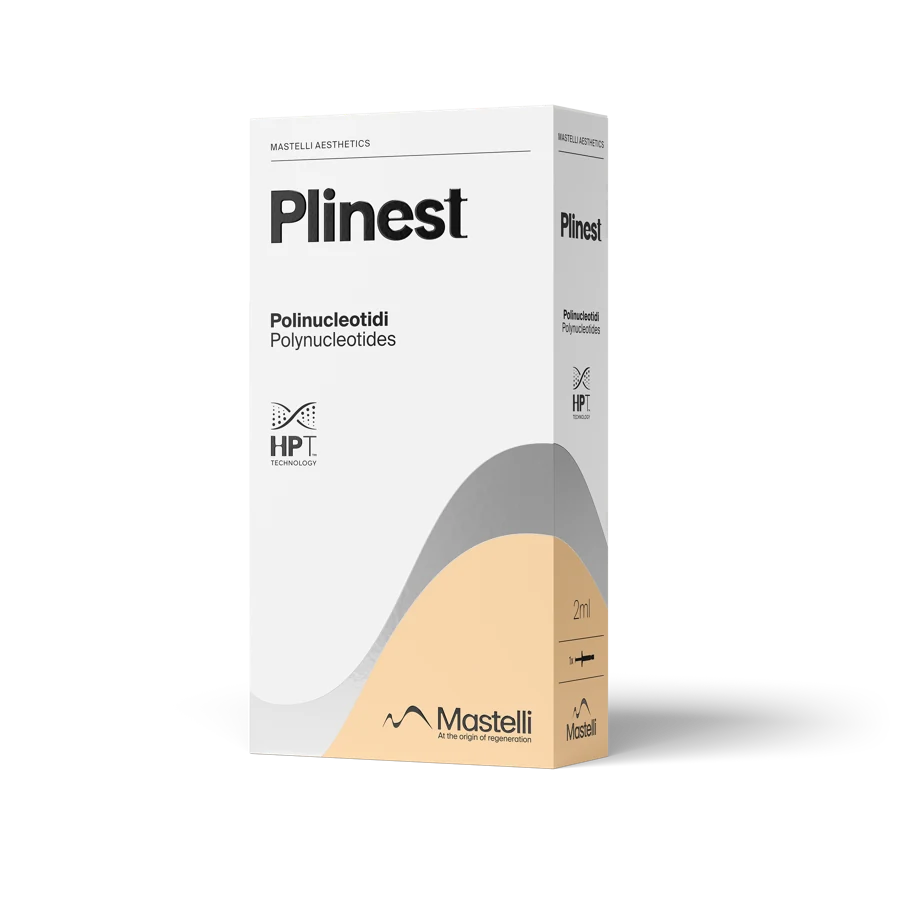
For example, Mastelli lists Plinest, Plinest Eye and Plinest Hair as separate products. Read the concentration and usage guidance for the specific formulation, and ask whether the clinic offers the one you are interested in. [2] [3] [4]
What do 20 mg/mL and 40 mg/2 mL mean?
Product figures can be written in different ways. HP VITARAN lists PN at 20 mg/mL, while standard Plinest lists 40 mg in 2 mL. Dividing by the volume gives the same concentration: 20 mg/mL. [1] [2]
Read the numbers in two parts. The mg/mL figure tells you how much PN is in each millilitre. The mg per syringe figure tells you the total PN in that syringe. At 20 mg/mL, 1 mL contains 20 mg of PN and 2 mL contains 40 mg.
When you see 40 mg per syringe compared with 20 mg per syringe, check the syringe volume too. The larger amount may come from a larger volume; the number alone does not establish better results.
THE EVIDENCE EDIT
Same concentration. Different volume.
What do manufacturing technology and material sources tell you?
Plinest uses Mastelli’s HPT® technology. Vitaran has separate product and manufacturing information from BR PHARM. These details help explain a product’s background, but a claim that one brand causes less irritation or allergy needs evidence for that specific comparison.
Fish names need to be read carefully too. BR PHARM specifies Oncorhynchus mykiss, commercially referred to as rainbow trout or salmon trout. Seeing “salmon” and “trout” does not by itself establish a difference in treatment outcomes between the brands. [5]
How does the research behind PN HPT® inform a choice of Plinest?
Once the product and amount are clear, turn to the research. For Plinest, distinguish two parts: the research background of PN HPT® technology and studies that specifically used Plinest.
THE RESEARCH BEHIND THE CHOICE
100+The PN HPT® research background
Plinest distributor materials state that PN HPT® is supported by more than 100 published clinical studies. This figure refers to the PN HPT® technology family used in Plinest and should be read separately from a count of studies on Plinest alone.
Explore the source on the main PN page ↗According to distributor materials · Slide Plinest, page 13
FROM TECHNOLOGY TO PRODUCT
What about studies of Plinest itself?
One example followed Plinest use on the face, neck and décolleté in 66 adults, assessing changes after a series of treatments. You can examine where the product was used and how the researchers followed the outcomes. Read the study ↗
For acne scars, a PN-HPT study involved 20 women and included a saline comparison group. Research that matches your treatment area and concern is more useful to your decision. This study did not compare Vitaran directly with Plinest. [6]
If the technology’s origins and research matter to you, this is one reason to consider Plinest. You can explore both PN HPT® information and studies of the product itself, then weigh them alongside your skin-care goals and budget.
Explore Plinest and the programmes at BEHAP ↗Choose with the whole plan in view
Before deciding, ask about the exact product, amount, price per session, number of sessions and what the service includes. Together, these give you a clearer total budget than the price per syringe alone.
Return to BEHAP’s main PN page to compare the Vitaran and Plinest options. Use your treatment area and the product you are interested in as the starting point when asking about a plan.
This article provides general information, not personalised medical advice. PN injections are a medical procedure. Results can vary, and medical history and suitability must be assessed before treatment.