
XERF Program: 300 vs 600 Shots — What’s the Difference?
One study used an average of 568.8 shots per session across the face and neck. Another used 600 shots on the face in one session. Read the methods and you’ll see that the numbers are close, but the shots went to different areas.
How many shots did XERF Program studies use?
300–677 shots per session. Weiss and colleagues (2026) followed 39 participants across four centres. Each participant had two sessions. The study reported a mean of 568.8 shots per session across the treated areas on both sides of the face and neck. Weiss et al.
600 shots in one session. In a retrospective study of 16 women, Erlich and colleagues (2026) used 300 shots on the mid and lower face and 300 on the upper face. The upper face was treated with smaller tips. Erlich et al.
Hwang’s 2025 study followed 20 women after one session. The abstract we could verify did not give a shot count. Hwang
The two studies that reported counts covered different areas and used different treatment plans. Neither assigned participants to 300- and 600-shot groups for a direct comparison, so these figures describe the study plans. They cannot tell us how much difference the extra shots would make on their own.
What does one shot tell you?
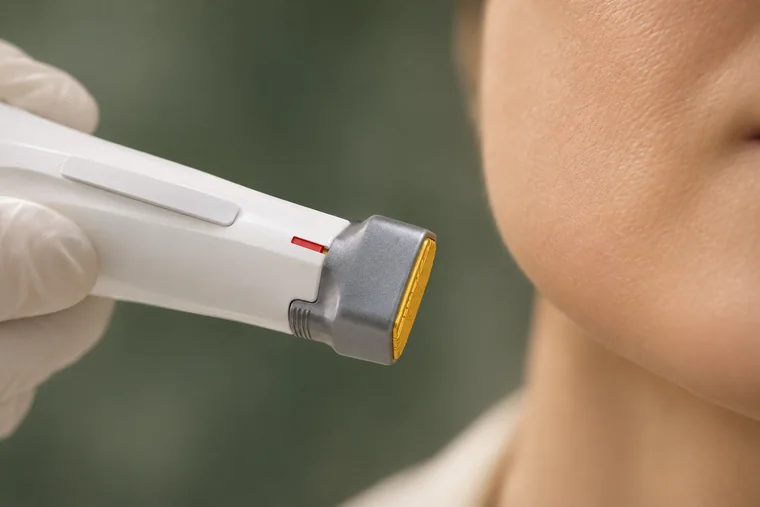
In the XERF Program, each delivery of radiofrequency energy through the tip counts as one shot. Your doctor can choose the depth and energy for each spot, so a shot on your cheek may use different settings from one along your jaw. Once the doctor knows the area to cover and how many passes it needs, the shot count begins to make sense.
The XERF Program offers three depth modes
Dual-frequency monopolar RF · 6.78 MHz + 2 MHz
How can you use those numbers at a consultation?
Start with what you’d like to see in the mirror. You might want more definition just where your lower cheek meets the jaw, or you might want to include the area under your chin. Ask your doctor to show where each plan would focus. In the examples below, 300 shots are allocated to a smaller area, while 600 can cover more areas or allow an extra pass where needed.
A smaller area to focus on
If your priority is the stretch where your lower cheek meets the jaw, your doctor may be able to concentrate 300 shots there. Ask where that stretch begins and ends. Does it cover the whole area you had in mind?
Room to cover more ground
A plan that includes your cheeks, jawline and under your chin needs shots to distribute across all three areas. With 600, your doctor can also allow for an extra pass where the examination suggests it would help. Skin condition and tissue response influence the result, so doubling the count won’t tell you how much change to expect.
These examples draw on How BEHAP plans the XERF Program
Ask your doctor to show you in the mirror
At your consultation, point out what concerns you in the mirror and ask, “Where would you focus the first 300 shots? With 600, what else would you treat, and how would you choose the depth for each area?” Your doctor might suggest including the area under your chin, making another pass along the same stretch of jaw, or choosing different depth modes for different areas to suit your concerns.