

Physiotherapy journal | BEHAP Wellness Clinic
What is dry needling?Understanding muscle needling and trigger points
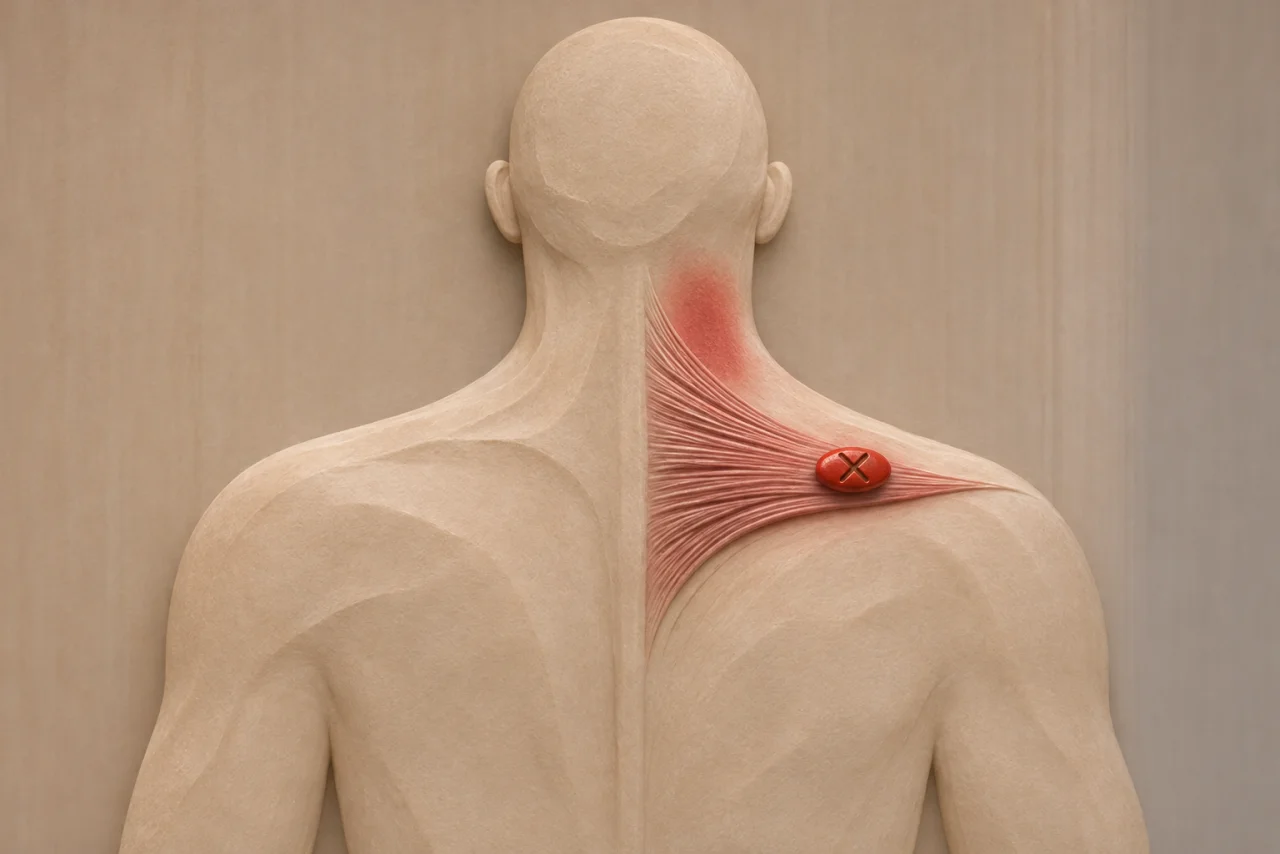
Neck pain can be related to muscles around the shoulder. During an examination, a physiotherapist therefore considers both where you feel the pain and which movements bring it on. [1,12]
If a tender spot in a muscle appears to be related to your symptoms, the physiotherapist may use a fine, solid needle to stimulate the area for short-term pain relief. This is called dry needling. No medicine is injected through the needle. [2–4,12]
What is a trigger point?
A trigger point is a small, pressure-sensitive spot in a taut band of muscle. Pressing it may hurt at that spot or reproduce pain elsewhere—for example, pressure on the shoulder may bring on pain in the neck. [1]
During the examination, the physiotherapist asks whether the pain felt when the spot is pressed resembles your everyday symptoms, then checks which movements reproduce the same pain. Together, these findings help establish how much that muscle may be contributing to your symptoms. [1,12]
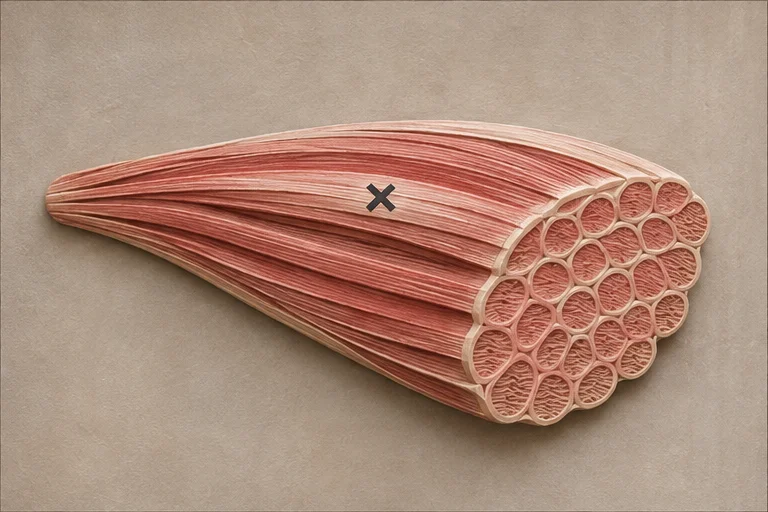
Image explanation: A trigger point in a taut band of muscle, marked with a cross over the muscle fibres.
A 3D illustration showing that pressure on a trigger point may cause pain locally or in another area. The cross marks an example tender spot.
How might dry needling relieve pain?
When a needle stimulates muscle at a trigger point, the tissue and nervous system may respond to pain differently. Researchers are still studying how this response contributes to pain relief. [1,10]
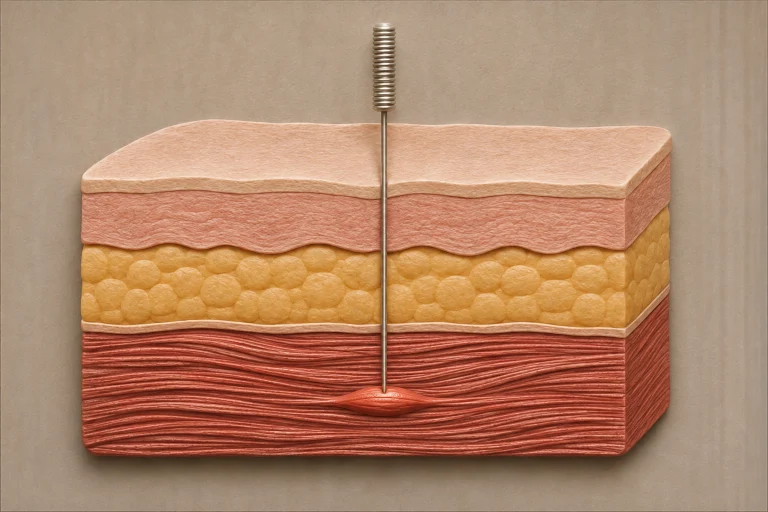
- 1Fine, solid needle
- 2Skin
- 3Subcutaneous tissue
- 4Muscle
What might I feel during treatment?
You may feel tightness or discomfort where the needle is inserted, and sometimes a brief muscle twitch. The strength of a twitch does not tell us how much pain relief you will get afterwards. Tell the physiotherapist straight away if the discomfort makes you want a break. [1,9,10]
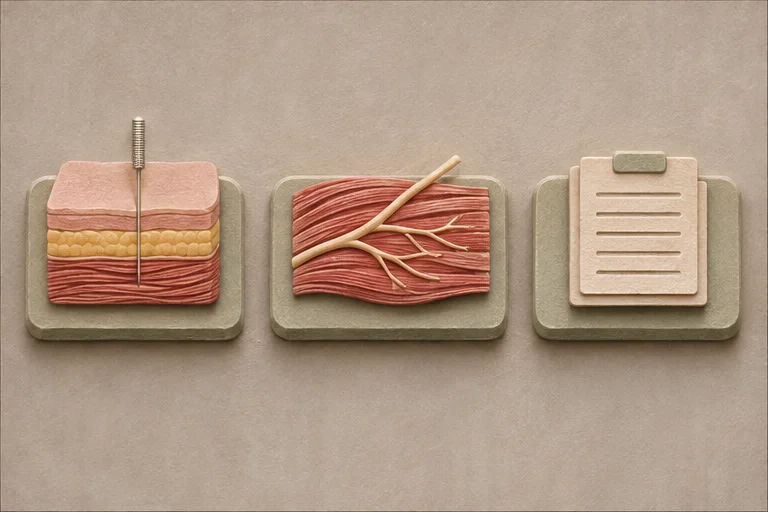
Needle stimulation
Tissue and nervous system responseAn explanation under study
Assess pain and movement
How do I assess the result afterwards?
Compare a movement that used to hurt. If turning your head was painful, notice whether it hurts less afterwards and whether you can turn further. Sometimes pain eases even though you can only turn as far as before. [1,10,12]
Which types of pain might dry needling help?
Neck and shoulder pain
If you have neck or upper shoulder pain and the examination links it to a muscular trigger point, the physiotherapist may consider dry needling for short-term pain relief. [1,3,4,12]
If shoulder pain makes reaching difficult, the physiotherapist also checks how far the shoulder joint moves. Pain arising from a muscle and a frozen shoulder require different approaches. [13–15]
Chronic low back pain
If ongoing low back pain makes it difficult to get out of a chair, the physiotherapist checks whether the pain starts as you lean forward or as you straighten up. If the examination suggests that muscle is contributing to the pain, dry needling may be used for short-term relief alongside exercise. [5,12]
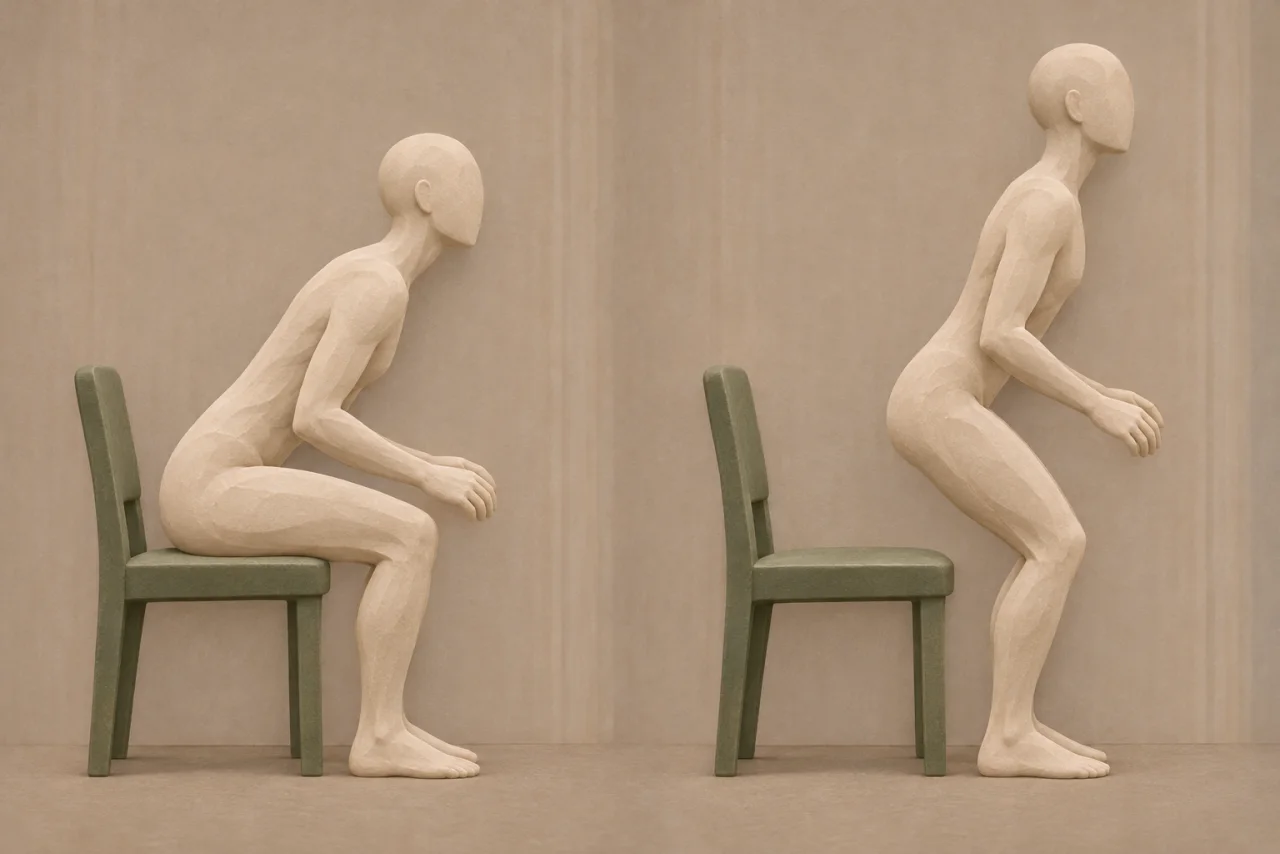
Two phases of standing up from a chair. Notice which part brings on your back pain and whether that same part feels easier after treatment.
If getting out of a chair feels easier at the clinic, the next thing to notice is how comfortably you can still do it at home. If it remains painful or difficult, the physiotherapist uses this information to adjust the exercises or investigate other causes. [5,12,13]
How does dry needling differ from other treatments?
Trigger points can be treated with needles or with acoustic waves delivered from outside the body. The choice depends on the area causing pain, the examination findings and the activities you want to do more comfortably again. [1,6–8]
| Treatment | What it involves | How it informs the choice |
|---|---|---|
| Dry needling | Fine needles stimulate muscle and tissue without injecting medicine. | Considered when the examination suggests that the tender muscle is related to the symptoms troubling you. [1,10] |
| Acupuncture | It has its roots in traditional Chinese medicine; point selection depends on the approach used. | Some approaches also treat trigger points, so the two methods have some similarities. [6] |
| Shockwave Therapy Program | Acoustic waves are delivered into tissue from outside the body, without passing a needle through the skin. | If you have muscular neck or upper back pain and prefer to avoid needles, ask the BEHAP team whether shockwave therapy is suitable for the area that hurts. [7] |
| Trigger Point Injection Program | A doctor injects a local anaesthetic, such as lidocaine, at a trigger point to relieve pain. In selected cases, a corticosteroid may be added to reduce inflammation. [14] | For neck pain related to a trigger point, a local anaesthetic injection may provide more short-term pain relief than dry needling. After the injection, also notice how much more easily you can move your neck. [8] |
How is treatment planned?
If pain continues after physiotherapy, the doctor reassesses its cause before considering an injection. With shoulder pain in particular, it matters whether the symptoms arise from muscle or from the shoulder joint.
If the examination identifies a muscular trigger point related to the symptoms, the doctor may inject a local anaesthetic into the muscle at that spot for pain relief. Local anaesthetic alone is generally an option. The doctor considers adding a steroid only in selected cases after assessing the benefits and risks. [14]
If reaching is difficult because of a frozen shoulder, the doctor may consider a steroid injection directly into the shoulder joint to help relieve pain in the short term. [15]
How many dry needling sessions will I need?
The number depends on your symptoms and the activities you want to return to. At follow-up, the physiotherapist checks how long the relief lasted and which movements remain difficult, then considers whether to continue or adjust the rehabilitation plan. [12,13]
Dry needling price
THB 1,500 per area
What should I tell the team before dry needling?
Tell the BEHAP team before treatment if any of the following applies, so they can consider whether to go ahead as scheduled, postpone treatment or choose another approach.
- A tendency to bleed easily
- Medicines you currently take, especially antiplatelets or anticoagulants
- Pregnancy
- A weakened immune system
- Fear of needles
- Wounds or infection
If you take medicine that increases bleeding risk, do not stop it on your own in preparation for dry needling. [1,11,12]
Side effects and symptoms to watch for
Possible effects include soreness, minor bleeding or bruising where the needle was inserted. Some people may feel lightheaded or faint.
If you are concerned about soreness or bruising afterwards, contact the BEHAP team here. [9,12]
What should I do if I have chest pain or breathlessness?
Pneumothorax—air in the space around the lung—has been reported after needling around the neck, shoulders or upper back. It can cause the lung to collapse, and symptoms may begin after you have left the clinic.
If you are still at the clinic and develop chest pain, breathlessness or difficulty breathing, tell the team immediately so treatment can be stopped, you can be assessed and transfer arranged if needed.
If you have left the clinic and develop these symptoms, go to an emergency department immediately and tell staff you recently had dry needling. [10,16]
Frequently asked questions about dry needling
Does dry needling hurt?
You may feel pain, tightness or a brief muscle twitch as the needle is inserted. If it hurts too much or you feel uncomfortable, tell the physiotherapist to pause or stop immediately. Afterwards, you may have soreness or bruising where the needle was inserted. [1,9,12]
Can one session resolve the problem?
Some people feel less pain after the first session, but symptoms may still trouble them when they return to work or everyday activities. Tracking how long the improvement lasts helps determine whether further treatment is appropriate. [2,12,13]
Does dry needling involve injecting medicine or steroids?
No. Dry needling uses a fine, solid needle to stimulate muscle, so no local anaesthetic or steroid passes through it. [8,10]
Does BEHAP offer steroid injections at trigger points?
Yes, in selected cases. The doctor examines the cause of the pain and assesses the risks before deciding whether to use a steroid together with a local anaesthetic.
Does everyone with desk-related pain need dry needling?
No. The physiotherapist asks when the pain occurs during the day and which movements it relates to, then examines movement and muscles. Some people may start with movement practice or exercise; others may have dry needling alongside these approaches. [2,3,12]
Can I have dry needling if I take antiplatelet or anticoagulant medicine?
Some people can. Tell the team which medicine you take beforehand so they can assess bleeding risk and choose a suitable area for needling. Do not stop the medicine on your own in preparation for dry needling. [11]
Should I wait if I have chest pain or breathlessness afterwards?
Do not wait to see whether it improves. If you develop chest pain, breathlessness or difficulty breathing while still at the clinic, tell the team immediately so treatment can be stopped and you can be assessed. If you have left the clinic, go to an emergency department immediately and tell staff you recently had dry needling, even if the symptoms have only just started. [10,16]
Start with an assessment of your pain
If you would like to arrange an assessment with the BEHAP team, useful details to share beforehand are where you feel pain, when it started and which everyday activities are currently difficult.
Explore physiotherapy and contact options at BEHAP
References
- McAphee D, Bagwell M, Falsone S. Dry Needling: A Clinical Commentary. 2022. doi:10.26603/001c.35693
- Kużdżał A, et al. How effective is dry needling? an umbrella review. 2026. doi:10.1186/s12906-026-05607-9
- Navarro-Santana MJ, et al. Effectiveness of Dry Needling for Myofascial Trigger Points Associated with Neck Pain Symptoms. 2020. doi:10.3390/jcm9103300
- de Sire A, et al. Effects of dry needling on functioning and pain relief in patients with chronic nonspecific neck pain. 2026; online 2025. doi:10.1080/09638288.2025.2529423
- George SZ, et al. Interventions for the Management of Acute and Chronic Low Back Pain: Revision 2021. doi:10.2519/jospt.2021.0304
- NCCIH. Acupuncture: Effectiveness and Safety
- Wu T, et al. Efficacy of extracorporeal shock waves in the treatment of myofascial pain syndrome. 2022. doi:10.21037/atm-22-295
- Navarro-Santana MJ, et al. Dry Needling Versus Trigger Point Injection for Neck Pain Symptoms Associated with Myofascial Trigger Points. 2022. doi:10.1093/pm/pnab188
- Boyce D, et al. Adverse Events Associated With Therapeutic Dry Needling. 2020. doi:10.26603/ijspt20200103
- Bontinck JSB, Lyphout C, Malfait TLA. Pneumothorax as a complication of dry needling technique. 2024. doi:10.1183/23120541.00156-2024
- Muñoz M, et al. Dry Needling and Antithrombotic Drugs. 2022. doi:10.1155/2022/1363477
- Treatment Guidelines and Decision Tree for Dry Needling Musculoskeletal Conditions: A Consensus Statement. 2026. doi:10.26603/001c.161025
- Chys M, et al. Clinical Effectiveness of Dry Needling in Patients with Musculoskeletal Pain—An Umbrella Review. 2023. doi:10.3390/jcm12031205
- Benzon HT, et al. Use of corticosteroids for adult chronic pain interventions: sympathetic and peripheral nerve blocks, trigger point injections. Reg Anesth Pain Med. doi:10.1136/rapm-2024-105593
- Rupani N, Gwilym SE, on behalf of the BESS Frozen Shoulder Working Group. British Elbow and Shoulder Society patient care pathway: Frozen shoulder. Shoulder Elbow. 2025;17(4):351–363. doi:10.1177/17585732251335955
- Mintken PE, et al. Pneumothorax After Dry Needling of Intrascapular Muscles Using a Rib Bracketing Technique. 2025. doi:10.1093/ptj/pzaf078